

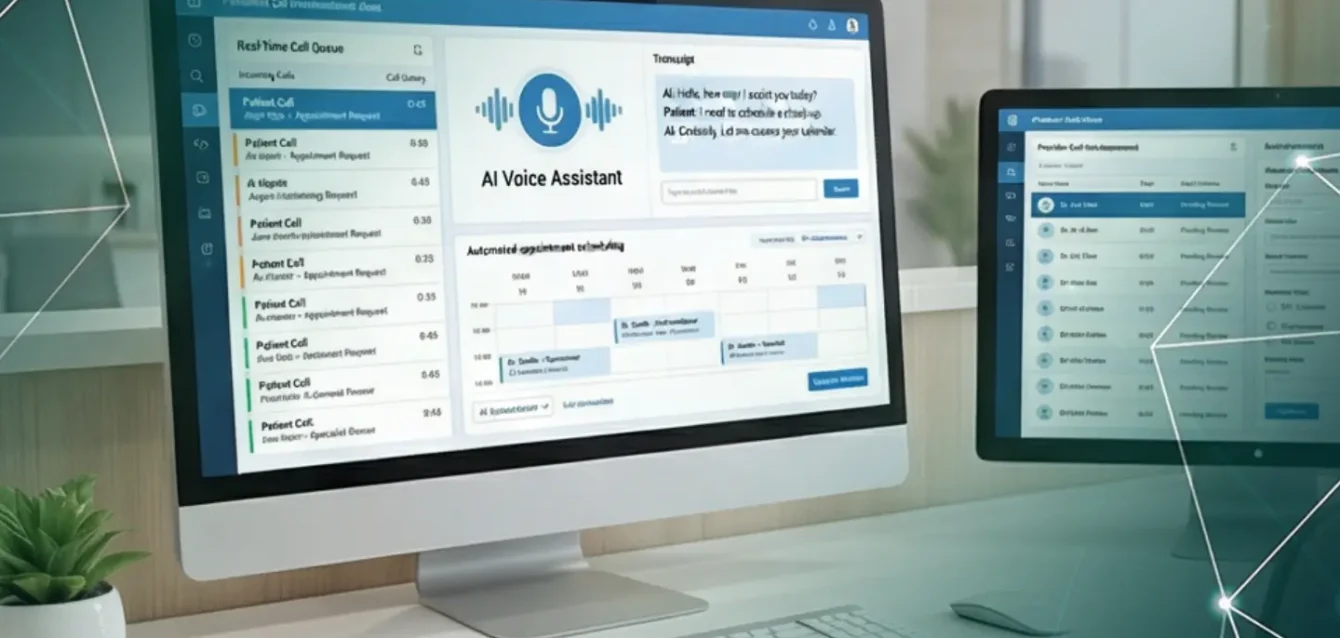
Front-desk teams are the heartbeat of a practice. They’re the first voice patients hear, the ones who juggle calls, check-ins, scheduling, reminders, and insurance questions all while managing a waiting room that never slows down.
But the reality is simple: patient communication is getting harder.
Call volumes are rising. Appointment requests come through multiple channels. Patients expect faster responses. Front-desk teams feel the pressure. And even the most efficient staff can’t pick up every call the moment it rings.
This is where AI voice agents are stepping in not to replace the front desk, but to support them. The shift is already happening across healthcare, and for many practices, it’s becoming a way to eliminate communication bottlenecks without adding more staff.
This blog explores how AI voice agents work, what they can (and cannot) do, and why practices are considering them as an extension of their team. While Claimity doesn’t offer voice agent services, understanding this technology helps practices build stronger operational habits that support a smooth revenue cycle.
Why Patient Communication Is Getting Harder for Practices
Every day, your front desk faces competing priorities:
– answering high-volume calls
– handling walk-ins
– managing appointment slots
– verifying insurance
– sending reminders
– collecting patient documents
– addressing last-minute cancellations
– supporting providers
Even a small delay creates a chain reaction:
Missed calls → missed appointments → delayed care → delayed billing → revenue disruption.
Industry data highlights the challenge:
Many practices continue to rely heavily on phone contact: a 2021 poll by Medical Group Management Association (MGMA) found that about 66% of practices use phone calls for patient appointments rather than digital tools.
This isn’t a staffing problem. It’s a volume-and-capacity problem.
Front-desk teams are doing their best but the system around them is stretched thin.This is where AI voice agents offer real relief.
What Exactly Are AI Voice Agents?
AI voice agents are automated conversational systems that interact with patients over the phone in real time.
They don’t read scripts like old IVR systems (“Press 1 for appointments…”). Instead, they understand natural speech, respond conversationally, and complete tasks automatically.
They can be trained to handle:
– appointment scheduling
– appointment reminders
– insurance verification prompts
– Frequently asked questions
– prescription refill requests
– callback requests
– post-visit instructions
– payment reminders
– lab result status responses (not clinical interpretation)
Think of them as a digital teammate who handles routine calls so your human staff can focus on more complex requests.
How AI Voice Agents Improve Front-Desk Efficiency
Practices adopting AI voice agents often notice an immediate difference.
Here’s how they transform everyday operations.
1. Reduced Call Wait Times
One of the biggest frustrations for patients is waiting on hold.
AI voice agents eliminate that because they answer instantly even during peak hours.
That means:
– fewer missed calls
– fewer voicemails
– fewer call-backs
– higher patient satisfaction
Patients get immediate attention, and your staff gets fewer overwhelmed moments.
2. Automated Appointment Management
Scheduling and rescheduling take up a large portion of your front desk’s day.
AI voice agents handle this smoothly.
They can:
– offer available slots
– book appointments
– confirm upcoming visits
– handle cancellations
– fill openings through automated outreach
The front desk spends less time on manual scheduling and more time assisting patients in front of them.
3. After-Hours Support Without Additional Staff
Practices lose many patient interactions simply because calls happen outside operating hours.
AI voice agents fill that gap.
When the office is closed, they can:
– answer basic questions
– book appointments
– send urgent messages to the on-call team
– capture new patient inquiries
– record detailed requests
Instead of waiting until the next day, patients get help on their timeline.
4. Streamlined Prescription-Related Calls
Prescription calls consume significant staff time.
AI agents can:
– capture refill requests
– verify patient identity
– confirm pharmacy details
– route requests to clinical teams
This reduces backlogs and keeps your clinical workflow running smoothly.
5. Standardized Communication Across All Calls
Human conversations vary. That’s natural. But in healthcare, inconsistency can lead to:
– scheduling mistakes
– incorrect instructions
– missed questions
– documentation gaps
AI agents deliver consistent responses every time.
Nothing is forgotten, skipped, or misunderstood.
6. Lower Administrative Burnout
Burnout is real.
Front-desk teams face long hours, constant interruptions, and high emotional load.
AI voice agents reduce stress by:
– handling repetitive tasks
– automating routine questions
– managing after-hours inquiries
– supporting peak-time call surges
– organizing essential information
Staff stay balanced, less overwhelmed, and more focused.
What AI Voice Agents Cannot Replace
AI voice agents help, but they cannot replace the human connection that healthcare requires.
They cannot:
– provide clinical advice
– navigate sensitive or emotional conversations
– replace the personal touch in complex scenarios
– handle specialized insurance questions
– manage escalations without human review
AI voice agents are supplements, not substitutes.
They create room for your staff to do what humans do best: empathy, problem-solving, and guidance.
How This Technology Supports a Healthier Revenue Cycle
Even though voice agents are not part of Claimity’s offerings, they indirectly help practices create stronger billing outcomes.
Here’s how improved communication supports revenue.
Fewer Missed Appointments
When scheduling is seamless and reminders are automated, fewer patients miss visits.
This protects your weekly revenue flow.
Faster Eligibility and Documentation Collection
AI voice agents can start gathering:
– insurance details
– prior coverage questions
– referral confirmations
This reduces preventable denials caused by missing information.
Better Patient Payment Compliance
Automated payment reminders are more consistent than manual outreach.
Patients receive clear instructions and next steps.
More Accurate Patient Information
Because AI captures information consistently, errors are less common.
Cleaner data leads to cleaner claims.
Stronger Staff Focus on Billing-High-Impact Work
When front-desk teams aren’t overwhelmed by calls, they can:
– verify insurance more carefully
– prepare documentation properly
– communicate coverage details clearly
– support the billing team proactively
This builds a healthier revenue cycle from the very first touchpoint.
Real-World Use Cases: What AI Voice Agents Handle Daily
Here’s how practices use voice agents across routine workflows:
New Patient Intake
AI agents gather:
– name
– DOB
– insurance provider
– reason for visit
– preferred appointment slot
Staff start the process with all essential information in place.
Pre-Visit Reminders
Agents confirm:
– visit date/time
– instructions
– prerequisite forms
– copay details
Patients show up more prepared.
Post-Visit Follow-Up
AI can call patients with:
– check-in messages
– survey invitations
– follow-up scheduling prompts
This increases retention and engagement.
Handling Non-Urgent Questions
Patients frequently ask:
– “What are your hours?”
– “Where are you located?”
– “Do you accept my insurance?”
– “How do I prepare for the visit?”
AI agents answer instantly.
Managing Seasonal Volume
During flu season or school physicals, call spikes are intense.
AI voice agents absorb the overflow without affecting the staff’s day.
The Human + AI Model: The Most Effective Approach
The best-performing practices don’t try to replace staff.
They create collaboration:
AI voice agents handle:
– routine inquiries
– scheduling
– reminders
– FAQs
– overflow calls
– data collection
Front-desk teams handle:
– patient-facing empathy
– escalations
– insurance complexities
– in-person questions
– clinical coordination
– sensitive discussions
It’s not about choosing between AI and people.
It’s about allowing each to do what they do best.
Why Practices Are Exploring Voice Agents Now
Three major shifts are accelerating adoption:
1. Rising Patient Expectations
Today’s patients expect:
– instant callbacks
– easy scheduling
– clear instructions
– 24/7 support
AI fills gaps without straining staff.
2. Workforce Shortages
Hiring trained front-desk staff is becoming harder.
AI voice agents help reduce dependency on expanding headcount.
3. Competition Among Practices
Faster communication improves:
– patient satisfaction
– online reviews
– retention
– referral rates
Practices using AI communication tools often outperform those that don’t.
What to Consider Before Adopting AI Voice Agents
Since Claimity doesn’t offer voice agent solutions, here are neutral considerations to help you evaluate vendors:
– Can the AI understand natural conversations accurately?
– Does it integrate with your EHR or phone system?
– Are calls recorded and auditable?
– Is patient data kept secure and HIPAA compliant?
– Are workflows customizable to your practice’s needs?
– Can staff take over calls instantly when needed?
– What reporting and analytics are included?
These factors determine whether the system helps or complicates your operations.
Conclusion: Voice Agents Are Not the Future – They’re Already Here
AI voice agents are reshaping how practices communicate with patients.
Not by replacing humans, but by supporting the front desk with the kind of consistency, speed, and availability that modern patients expect.
The benefits are clear:
– lower wait times
– reduced missed calls
– more efficient scheduling
– less administrative strain
– better patient experience
– higher operational stability
As practices continue facing rising demand and limited staffing, AI voice agents offer a pathway to healthier operations and more reliable communication.
While Claimity doesn’t provide voice agent solutions, understanding how this technology works helps practices build stronger workflows and a smoother revenue cycle.
Because the end goal is simple:
Support your team. Serve your patients better. Keep your operations predictable.
FAQs
No. They handle routine calls so staff can focus on complex, high-value interactions.
Yes. Studies show patients appreciate instant responses and shorter wait times.
Reputable vendors meet HIPAA standards, but practices must confirm compliance before adoption.
Most systems can depend on integration capabilities.
They help practices manage call volume without increasing staffing, which reduces administrative expense over time.
