

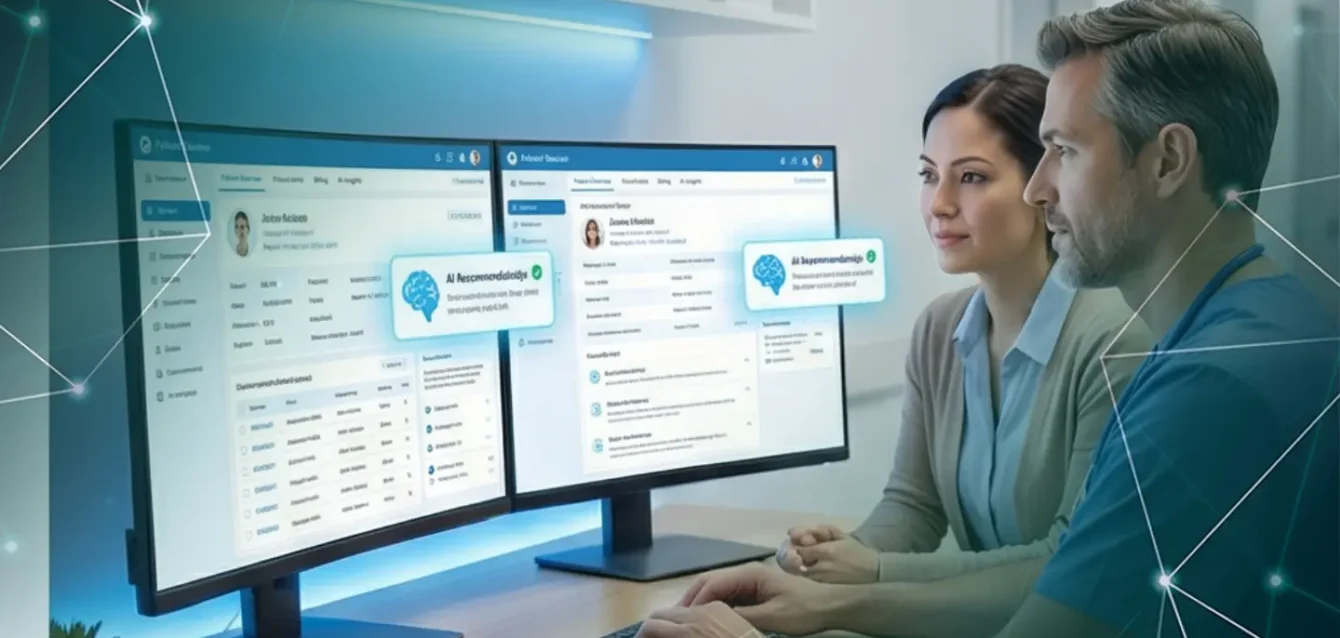
A physician finishes a patient visit, closes the exam room door, and turns to the computer. What should take two minutes stretches into ten notes, codes, orders, clicks, and more clicks. The patient experience just ended, but the work didn’t. This scenario is all too familiar across healthcare today. Electronic Health Records (EHRs) were built to organize care, improve accuracy, and support better outcomes. Yet over time, they’ve become one of the biggest sources of friction in clinical workflows.
The problem isn’t lack of care or training, it’s workflow fatigue. Physicians spend more time interacting with screens than with patients, and the invisible burden of documentation starts to affect both efficiency and patient satisfaction. This is where AI EHR integration comes in not to replace humans, but to remove friction and allow Physicians to focus on meaningful care.
In this blog, we explore how AI partners with humans in healthcare, improving EHR workflows while preserving the human touch. We’ll look at common pain points, how AI alleviates them, and why BillCycle’s approach ensures Physicians and patients remain at the center of care.
Why EHR Workflows Can Feel Overwhelming
EHRs succeed in storing patient records, tracking clinical decisions, supporting compliance, and enabling billing. However, the day-to-day experience often feels very different. Physicians face repeated tasks, constant screen switching, and rigid templates that rarely match real conversations. Much of this work extends beyond clinic hours, taking time away from rest, recovery, and patient interactions.
Common workflow pain points include:
- Re-entering patient data across multiple EHR screens
- Switching constantly between patient interaction and documentation
- Completing rigid templates that don’t align with actual conversations
- Extending documentation into evenings after clinic hours
Beyond operational issues, EHR fatigue is a major contributor to burnout. According to a 2022 report from the American Medical Association, over 60% of physicians report administrative burden significantly impacts job satisfaction. Burned-out Physicians inevitably affect patient experience with less eye contact, shorter visits, and reduced engagement. AI integration addresses these challenges, reducing unnecessary friction while keeping care quality intact.
What AI EHR Integration Really Means
There’s a lot of hype around AI in healthcare. Let’s clarify what AI EHR integration is and what it isn’t.
AI integration does not replace Physicians, make care decisions, or automate empathy. Instead, it quietly handles repetitive, rules-based tasks that distract from patient care. Think of AI as a co-pilot: it reduces manual effort while Physicians remain in control.
In practice, AI can:
- Analyze clinical notes and extract relevant information automatically
- Suggest accurate codes based on documentation
- Flag missing or inconsistent data before it causes downstream issues
- Automate routine tasks that don’t require human judgment
The goal isn’t faster clicks, it’s better care, less burnout, and smoother workflows.
How AI Improves Patient Experience
Patient experience isn’t only bedside manner, it’s influenced by time, attention, and continuity. Poor EHR workflows reduce face-to-face interaction, delay follow-ups, and create administrative frustration for patients and staff alike.
AI doesn’t interact directly with patients, but it creates conditions for enhanced patient experience:
- Faster completion of notes, freeing Physicians for direct care
- Reduced errors and delays in care coordination
- Smoother transitions between departments or specialists
- More accurate billing and financial transparency
For example, when AI prevents delays caused by missing documentation, patients avoid rescheduled appointments or delayed treatments. can focus more on discussions, answering questions, and building trust, which are the foundations of patient satisfaction.
Reducing Documentation Burden Without Sacrificing Accuracy
Documentation is essential, but over-documentation can be exhausting. AI integration:
- Transcribes visits in real time using Natural Language Processing (NLP)
- Structures notes for downstream use
- Flags missing or inconsistent information before submission
Studies show practices implementing AI-assisted documentation save 1–2 hours per day per provider, reducing burnout while maintaining accuracy. Physicians can reclaim time for patient care, teaching, or simply completing meaningful tasks instead of repetitive data entry.
Streamlining Team Workflows
Healthcare is inherently collaborative. Fragmented EHR workflows often create silos, with clinical, billing, and operations teams needing the same data in different formats. AI bridges these gaps by translating clinical notes into structured, actionable data for multiple teams.
For instance, when a clinical note is completed, AI can simultaneously:
- Flag missing codes for billing
- Summarize key patient information for operations
- Highlight clinical alerts for follow-ups
This multi-directional intelligence reduces miscommunication, prevents delays, and keeps patient care uninterrupted.
Supporting Compliance and Accuracy
Compliance is non-negotiable. AI EHR integration ensures that:
- Missing information is flagged before submission
- Audit trails are maintained for every action
- Documentation aligns with regulatory and payer requirements
Practices using AI-assisted compliance tools report up to 50% reduction in denials due to documentation errors. This not only protects revenue but also ensures consistent patient care.
Preserving the Human Touch
One of the biggest fears around AI is depersonalization. BillCycle’s philosophy is clear: AI supports humans, it doesn’t replace them.
AI frees Physicians to:
- Engage more fully with patients
- Respond promptly to concerns
- Maintain professional satisfaction without burnout
Explainable AI shows decision rationales, building trust among Physicians and patients alike. Human oversight ensures that AI recommendations respect patient preferences, cultural context, and nuanced clinical judgment. Surveys show practices maintaining this balance achieve 85% higher patient satisfaction scores.
Improving Revenue Integrity Without Hurting Patient Experience
EHR workflows influence financial performance. Incomplete documentation can lead to denied claims, delayed authorizations, and frustrated patients. AI reduces these issues by:
- Ensuring completeness and accuracy of documentation
- Aligning clinical notes with billing and payer requirements
- Automating verification tasks that often slow revenue cycles
For example, a Texas solo clinic using AI-EHR reduced accounts receivable from 45 to 22 days, added $150K in yearly revenue, and lowered denials from 18% to 4%. Patients benefit too, with fewer billing disputes and smoother care journeys.
Real-World Use Cases of AI EHR Integration
Primary Care: AI summarizes visits, flags missing details, and reduces charting time, allowing Physicians to focus on health concerns. Practices report 30% reduction in after-hours documentation.
Specialty Practices: Complex procedures require accurate documentation for approvals. AI ensures completeness, pre-checks authorizations, and minimizes workflow interruptions, reducing errors in cardiology, oncology, and other specialties.
Behavioral Health: Narrative-heavy therapy notes are interpreted by AI while maintaining Physician voice. Practices see 25% more time for patient interaction instead of documentation.
Chronic Care Management: AI maintains continuity, reduces manual tracking, and supports proactive follow-ups, ensuring coordinated care.
Implementation Steps for Small Practices
Phase 1: Pilot AI Documentation Tools
- Implement NLP scribes for routine documentation
- Train staff on human oversight
- Integrate with existing EHRs via APIs
Phase 2: Layer AI for RCM
- Apply AI coders and analytics for billing workflows
- Ensure interoperability via FHIR/HL7 standards
- Track KPIs: days in AR, denial rates, charge capture, and net collection percentage
Budgeting $5K–$20K annually for small practices is offset by measurable ROI. Staff upskilling and patient education ensure seamless adoption.
Overcoming Integration Hurdles
- Modular AI overlays avoid full EHR replacement
- Federated learning models keep sensitive data on-site
- Bias mitigation uses diverse datasets, audited quarterly
Vendor criteria: FHIR/HL7 compliance, SOC 2 Type II certification, transparent pricing, 24/7 support. These strategies allow small practices to implement AI without disrupting patient care.
Future Horizons for AI in RCM
By 2030:
- Generative AI may simulate payer negotiations to preempt denials
- Multimodal AI will integrate wearables with EHR for holistic insights
- Edge AI enables offline processing for rural practices
- Blockchain and quantum computing may secure data and optimize claims
Even as AI capabilities expand, the human core remains central, Physicians guide care, AI amplifies efficiency and insights.
Metrics-Driven Success Framework
| KPI | Baseline | AI-Enhanced Goal | Frequency |
| Days in AR | 45 | <25 | Monthly |
| Denial Rate | 15% | <5% | Weekly |
| Charge Capture | 85% | 98% | Daily |
| Net Collection % | 90% | 97% | Quarterly |
| Provider Time on EHR | 2 hrs/visit | <30 min | Bi-weekly |
Conclusion: Why BillCycle is Your Human-AI Partner
AI EHR integration transforms workflows, reduces physician burnout, and improves patient experience but only when implemented thoughtfully. BillCycle.ai goes beyond automation, delivering a human-validated AI platform that ensures efficiency, compliance, and compassionate care.
BillCycle empowers practices by:
- Integrating seamlessly with existing EHRs
- Reducing administrative burden while keeping Physicians in control
- Optimizing revenue cycle management for faster reimbursements
- Maintaining HIPAA-compliant, audit-ready workflows
- Reclaiming Physician time for meaningful patient interactions
- Enhancing patient experience through smoother, attentive care
With BillCycle, AI becomes more than a tool; it’s a strategic partner that strengthens your practice, supports Physicians, and elevates the patient experience. For small, specialty providers, and multi-location groups, BillCycle delivers measurable operational, financial, and clinical outcomes making the human-AI partnership a reality.
BillCycle.ai: technology that works quietly in the background, letting humans shine and care remain at the heart of healthcare.
FAQs
AI automation of repetitive tasks in EHR workflows while Physicians retain control and oversight.
No. It reduces manual tasks; humans make decisions and provide empathy.
By reducing delays, freeing Physician time, and enabling smoother care coordination.
Yes. BillCycle ensures HIPAA compliance, audit-ready trails, and transparency.
Start with pilot NLP scribes, add AI RCM tools, train staff, and monitor KPIs.
